In today’s competitive online marketplace, attracting visitors to your website is only the beginning. Businesses need a structured process that turns strangers into loyal customers. This is where the digital marketing funnel becomes essential. Whether you’re a startup, eCommerce business, educational institution, healthcare provider, or local business, understanding the customer journey helps you generate qualified leads, increase conversions, and improve return on investment (ROI).
A well-planned digital marketing funnel combines Search Engine Optimization (SEO), Search Engine Marketing (SEM), Social Media Marketing (SMM), Content Marketing, Email Marketing, Google Ads, Meta Ads, Conversion Rate Optimization (CRO), Analytics, Customer Relationship Management (CRM), and Marketing Automation to move users from awareness to purchase.
If you’re searching for a digital marketing agency in Kerala, understanding the marketing funnel will help you evaluate whether your agency is building long-term business growth instead of simply increasing website traffic.
What Is a Digital Marketing Funnel?
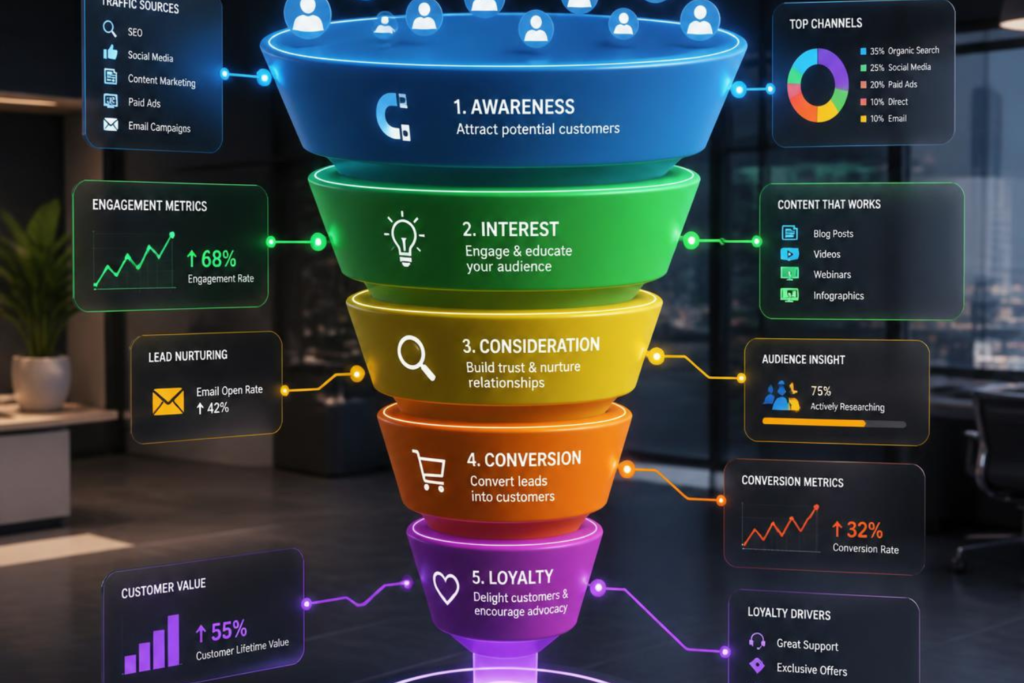
A digital marketing funnel is a visual representation of the customer’s buying journey. It explains how potential customers discover your brand, interact with your business, consider your products or services, make a purchase, and eventually become repeat customers.
The funnel narrows because many people become aware of your business, but only a percentage convert into paying customers.
The four primary stages include:
- Awareness
- Consideration
- Conversion
- Loyalty & Advocacy
Each stage requires different marketing strategies and customer engagement techniques.
Why Every Business Needs a Digital Marketing Funnel
Without a marketing funnel, businesses often focus only on generating traffic instead of converting visitors into customers.
A structured funnel helps businesses:
- Generate qualified leads
- Improve customer experience
- Reduce acquisition costs
- Increase conversion rates
- Build long-term customer relationships
- Measure marketing performance
- Improve advertising ROI
- Create predictable business growth
Whether you’re a local shop or a multinational company, every successful brand follows a customer acquisition process.
Stage 1: Awareness
The awareness stage introduces your business to people who have never heard of your brand.
Customers at this stage are searching for information rather than making immediate purchases.
Marketing Channels
- Google Search
- AI Search
- Google Business Profile
- YouTube
- Blogs
- Press Releases
- Influencer Marketing
SEO Strategies
- Keyword Research
- Technical SEO
- Local SEO
- On-page SEO
- Content Marketing
- Schema Markup
- Voice Search Optimization
Businesses working with a digital marketing agency in Kerala often begin with SEO because organic visibility generates sustainable long-term traffic.
Awareness Content Examples
Content should educate rather than sell.
Examples include:
- Educational blogs
- Infographics
- Social media posts
- Short videos
- Industry news
- FAQs
- Free guides
- Podcasts
Helpful content builds trust before customers make purchasing decisions.
Stage 2: Consideration
Once users know your business, they start comparing products, services, pricing, reviews, and expertise.
They ask questions like:
- Is this company trustworthy?
- Which solution fits my needs?
- What makes this brand different?
Effective Marketing Channels
- Case Studies
- Product Pages
- Landing Pages
- Comparison Articles
- Testimonials
- Google Reviews
- Email Marketing
- Webinars
This stage focuses on building authority and reducing uncertainty.
Importance of Social Proof
Modern consumers trust other customers more than advertisements.
Examples include:
- Customer Reviews
- Video Testimonials
- Success Stories
- User Generated Content
- Google Ratings
- Client Logos
- Awards
- Certifications
Trust signals significantly improve conversion rates.
Stage 3: Conversion
The conversion stage turns interested prospects into paying customers.
This stage requires a seamless buying experience.
Conversion Strategies
- Optimized Landing Pages
- Clear Call-to-Action
- Mobile-Friendly Website
- Fast Loading Speed
- Secure Payment Gateway
- Live Chat
- WhatsApp Integration
- Limited-Time Offers
- Free Consultation
Conversion optimization combines user experience with persuasive content.
Role of Performance Marketing
Performance marketing accelerates conversions using paid advertising.
Popular platforms include:
- Google Ads
- Meta Ads
- LinkedIn Ads
- YouTube Ads
- Display Advertising
- Shopping Ads
Remarketing campaigns also target users who previously visited your website.
Stage 4: Loyalty and Customer Retention
A successful funnel doesn’t end after the first sale.
Returning customers spend more and often recommend businesses to others.
Retention Strategies
- Email Newsletters
- Loyalty Programs
- Referral Programs
- Exclusive Discounts
- Customer Support
- Product Updates
- Personalized Recommendations
Retaining customers is usually more cost-effective than acquiring new ones.
Marketing Automation Improves Every Funnel
Marketing automation helps businesses communicate with customers at the right time.
Examples include:
- Welcome Emails
- Cart Abandonment Emails
- Follow-Up Campaigns
- Lead Nurturing
- Birthday Offers
- Product Recommendations
- CRM Automation
Automation saves time while improving customer engagement.
The Role of SEO Throughout the Funnel
SEO supports every stage of the marketing funnel.
Top of Funnel
Educational blog content attracts new visitors.
Middle of Funnel
Service pages answer customer questions and compare solutions.
Bottom of Funnel
Optimized landing pages encourage enquiries, bookings, or purchases.
Technical SEO, Core Web Vitals, structured data, semantic SEO, and entity optimization improve search visibility across the entire customer journey.
How AI Is Changing Digital Marketing Funnels
Artificial Intelligence is transforming customer acquisition.
Businesses now use AI for:
- Predictive Analytics
- AI Content Creation
- Chatbots
- Customer Segmentation
- Behaviour Analysis
- Marketing Automation
- AI Search Optimization
- Personalized Recommendations
AI helps marketers deliver more relevant experiences while improving conversion rates.
Why Choose a Digital Marketing Agency in Kerala?
A professional digital marketing agency in Kerala helps businesses create complete marketing funnels instead of isolated campaigns.
Services typically include:
- Search Engine Optimization (SEO)
- Local SEO
- Google Ads Management
- Meta Advertising
- Social Media Marketing
- Website Development
- Conversion Rate Optimization
- Email Marketing
- Analytics & Reporting
- Content Marketing
- Branding Strategy
- Marketing Automation
Experienced agencies use data-driven strategies to attract qualified traffic, improve conversions, and maximise return on investment.
Common Mistakes Businesses Make
Many businesses lose potential customers because they:
- Focus only on traffic
- Ignore SEO
- Have slow websites
- Lack clear CTAs
- Skip email marketing
- Don’t retarget visitors
- Ignore analytics
- Fail to optimise landing pages
Correcting these issues can significantly improve sales performance.
Conclusion
A digital marketing funnel is much more than a sales process. It is a complete customer journey that builds awareness, earns trust, generates qualified leads, increases conversions, and encourages repeat business. Businesses that combine SEO, content marketing, social media, paid advertising, marketing automation, analytics, and customer relationship management create sustainable growth rather than relying on one-time campaigns.
If you’re looking for a digital marketing agency in Kerala, choose one that understands every stage of the funnel—from awareness to loyalty—and uses data-driven, customer-focused strategies to deliver measurable business results.
Frequently Asked Questions (FAQs)
1. What is a digital marketing funnel?
A digital marketing funnel is a structured process that guides potential customers from discovering your brand to making a purchase and becoming loyal customers. It includes awareness, consideration, conversion, and retention stages, each requiring different marketing strategies to improve engagement, trust, and sales.
2. Why is a marketing funnel important for businesses?
A marketing funnel helps businesses understand customer behaviour, improve lead generation, increase conversion rates, reduce marketing costs, and build long-term customer relationships. It ensures marketing efforts focus on every stage of the customer journey instead of only attracting website traffic.
3. How does SEO support a digital marketing funnel?
SEO increases visibility during every funnel stage by helping businesses rank for informational, commercial, and transactional keywords. Optimized content, technical SEO, structured data, and local SEO attract qualified visitors, improve user experience, and increase conversions through organic search results.
4. What channels are used in the awareness stage?
The awareness stage uses channels such as Google Search, AI search engines, blogs, social media, YouTube, Google Business Profile, influencer marketing, and online advertising. These platforms help businesses reach new audiences and introduce their products or services effectively.
5. What is conversion rate optimization (CRO)?
Conversion Rate Optimization improves website performance by increasing the percentage of visitors who complete desired actions. It includes optimizing landing pages, improving page speed, simplifying navigation, enhancing calls-to-action, and creating better user experiences that encourage more enquiries or purchases.
6. How does email marketing fit into the funnel?
Email marketing nurtures leads throughout the funnel by sending educational content, personalised offers, follow-up messages, abandoned cart reminders, newsletters, and customer updates. It strengthens relationships, encourages repeat purchases, and supports long-term customer retention with automated communication.
7. Why should businesses hire a digital marketing agency in Kerala?
A professional digital marketing agency in Kerala provides expertise in SEO, social media marketing, Google Ads, content marketing, analytics, website optimization, and conversion strategies. Agencies create integrated marketing funnels that generate quality leads, improve ROI, and support sustainable business growth.
8. How can businesses measure funnel performance?
Businesses measure funnel performance using Google Analytics, Google Search Console, CRM reports, advertising dashboards, and conversion tracking. Important metrics include website traffic, click-through rate, conversion rate, bounce rate, lead quality, customer acquisition cost, and return on advertising investment.